Me and You Rules and Word Blocks
Learn the grammar that turns paper scraps into laws — then break those laws on purpose with your partner.
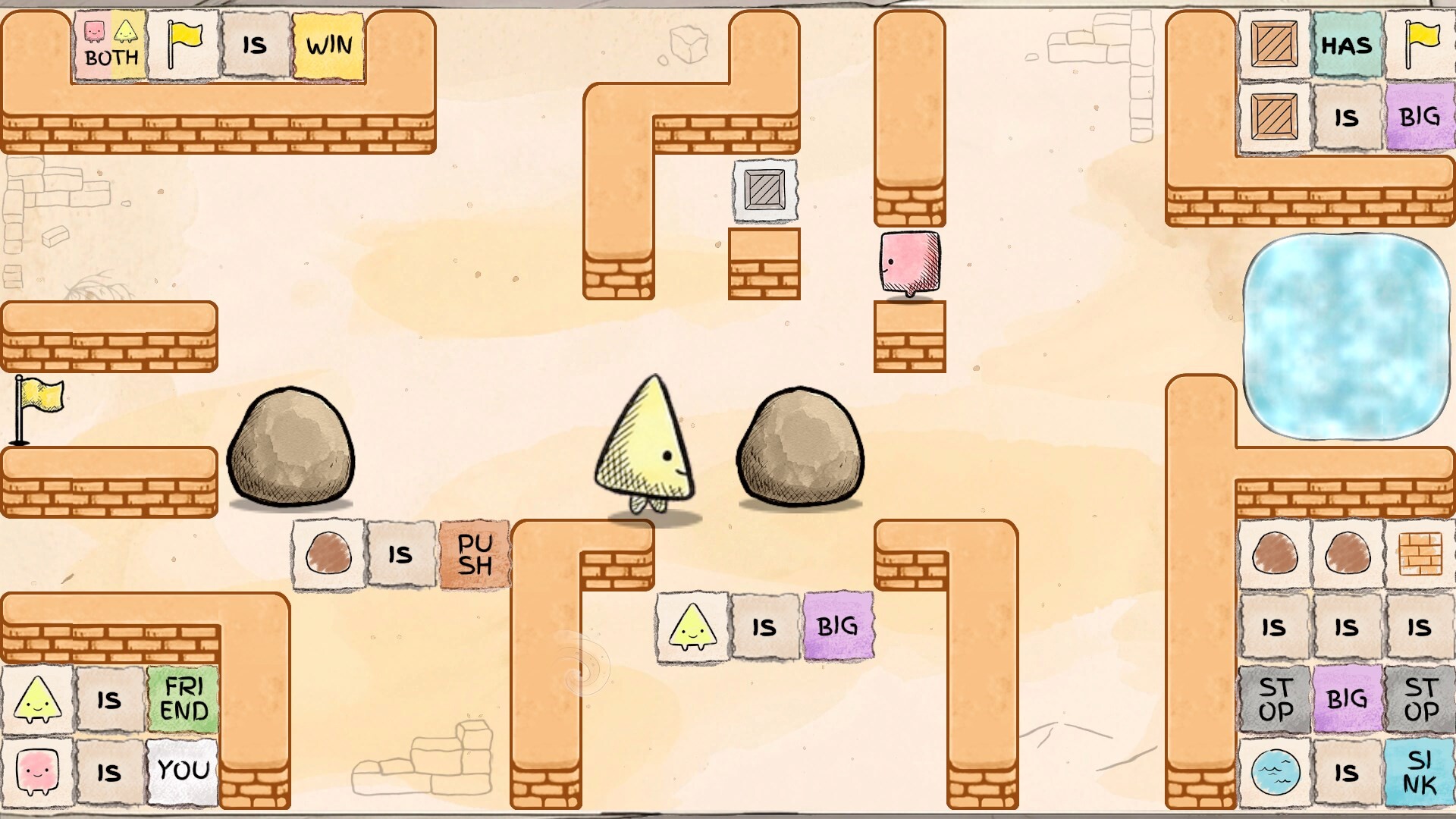
In Me and You, the rulebook is scattered across the floor. Paper scraps printed with words become law the instant you line them into a valid sentence. This guide is the grammar deep dive: how SUBJECT IS PROPERTY works, which common verbs and properties you will meet in the Steam demo, and how breaking or remaking sentences is the real skill. Read How to Play first if you still need the core loop. Use Demo Walkthrough when a named room refuses to click.
Word tiles versus world objects
Two layers share the grid:
- Word tiles (scraps of paper) — text you push into sentences. They are usually pushable objects themselves unless a rule says otherwise.
- World objects — flags, rocks, walls, water, characters, keys, thorns, and anything else the level author placed.
A noun word refers to a class of world objects. A property word describes behavior. The glue is almost always IS. When ROCK, IS, and PUSH sit in a straight contiguous line, every rock inherits pushability. Slide IS away, and rocks forget that behavior immediately.
The sentence shape that matters
Canonical form:
SUBJECT + IS + PROPERTY
Examples you will form or break constantly:
- FLAG IS WIN
- WALL IS STOP
- ROCK IS PUSH
- WATER IS SINK
- (character noun) IS YOU
Sentences must be aligned in a straight orthogonal line with no gaps. Diagonals do not count. Extra words jammed against a valid triple can invalidate or extend grammar depending on the authoring — when unsure, isolate the three tiles you care about and test with an undo-friendly push.
Some puzzles tease longer phrases or dual subjects. Demo titles like We are the key for all and We are together hint that plural or multi-actor identity matters. Still, train your eye on the basic triple first; flashy solutions usually rest on that foundation.
Property field guide
Exact tile lexicons can expand in the full November 25, 2026 release, but the demo repeatedly drills these ideas:
YOU
Marks which objects the players control. No YOU rule means nobody moves — instant soft-lock unless you undo. Dual YOU (both characters controllable) enables parallel play and “push it together” moments. Losing YOU on purpose can be correct if your partner remains YOU and your transformed body is the tool.
WIN
Marks the victory object or condition. Classic clear: a YOU body touches a WIN object. Levels such as The flag is win and You and flag teach this explicitly. Later rooms may make unexpected nouns WIN, or force you to change WIN mid-solution.
STOP
Solid collision. Walls usually IS STOP at the start of maze-like rooms. Breaking WALL IS STOP can open shortcuts; remaking it can trap hazards or pin objects. Is the wall a rock? style jokes ask you to question whether “wall” deserves STOP at all.
PUSH
Object can be shoved by a YOU actor (and sometimes by other moving pieces). Rocks often start as PUSH. Word tiles themselves typically behave as pushable so you can rewrite grammar — if words ever stop moving, look for a rule that stole their pushability or trapped them behind STOP.
SINK
Hazardous deletion or absorption, especially around water. Chapter 1 ends with Sink about it; Chapter 2’s Water Adventure leans on water interactions in rooms like Water castle and Water Thorns. SINK is a tool and a threat: sink a rock to clear a path, or watch your only key tile vanish because you forgot water was hungry.
Other transformational properties
Expect rules that change appearance and function — turning a partner into a door, rock, or wall, spawning keys “out of nowhere,” or making something openable. When a property seems cosmetic, test interaction: can you still push it? Does it block? Does touching it win?
Breaking rules on purpose
Beginners over-build. Veterans edit.
Ways to invalidate a sentence:
- Push the IS tile out of line
- Separate subject from property with a gap
- Cover or replace a word with another object if the level allows stacking interactions
- Change the subject noun so the property applies to something else entirely
Breaking STOP opens space. Breaking SINK saves objects. Breaking a redundant WIN might be required so a new WIN can take over without ambiguity. Always re-read the board after a break — side effects surprise teams who only watched the tile they touched.
Remaking rules: the real mastery loop
Many solutions follow this rhythm:
- Break an early-game safety rule to gain access.
- Use the temporary chaos to reposition words.
- Remake a tighter rule set that enables the win.
- Execute with both players synced.
Changeless and Lock style rooms punish careless permanent edits; Crossroads style rooms offer multiple grammar branches. When stuck, ask: “Which currently true sentence is lying to us about what this level wants?” Then break that liar on purpose.
Dual-player grammar tactics
Because every level is co-op authored:
- One player can hold a word in place while the other fetches IS.
- One body can become the subject object while the other remains YOU to shove remaining tiles.
- Simultaneous pushes matter when two rocks must slide on the same “turn” of thought — see titles like Push it together and Teamwork.
- Remote or online partners should announce sentence completion explicitly: “Rock is push is live.” Latency makes visual confirmation slower; verbal confirmation closes the gap. More on that in Co-op Tips.
Reading the board like a checklist
Train this scan every entry and after every major edit:
- List all complete IS sentences.
- Circle (verbally) who is YOU.
- Note every STOP perimeter.
- Note PUSH candidates and trapped words.
- Note SINK or hazard tiles.
- State the current WIN target — or admit there is none yet.
If step 6 fails, your next goal is not movement; it is manufacturing a WIN rule or transforming an object into one.
Soft-locks and recovery thinking
Common soft-locks:
- Zero YOU actors
- WIN object sunk or trapped forever
- Critical word cornered with no pull mechanic
- Both players transformed into STOP objects with no remaining YOU
Recovery order: Undo → inspect whether a different break sequence preserves the word → Restart only if the stack cannot reach a controllable state. Restart etiquette belongs in your house rules from Controls.
Practice drills (five minutes each)
- Sentence surgery: In a safe early room, break and remake FLAG IS WIN five times without restarting.
- YOU swap: Practice transferring control-related rules until both players can rebuild YOU blind.
- STOP door: Open a wall by breaking STOP, walk through, remake STOP behind you.
- SINK respect: Push a disposable rock into water on purpose, then solve without needing that rock.
Run these drills before Chapter 2 so Water Adventure teaches composition, not vocabulary panic.
How this page ties to the rest of the wiki
- New to the game? Getting Started
- Need the loop without lexicon density? How to Play
- Stuck on a demo title? Demo Walkthrough
- Inputs fighting you? Controls
- Hub index: Guides Hub
Me and You is generous once you treat text as machinery. Speak the sentences, break the ones that trap you, remake the ones that free you, and keep a partner who will tell you when WALL IS STOP is the quiet villain of the room.
Frequently Asked Questions
Quick answers to the most common questions.
What makes a rule “count”?
A subject word, IS, and a property word must form a straight, gapless line. When that happens, the property applies to matching objects until the sentence breaks.
Which properties show up most in the demo?
Expect heavy use of YOU, WIN, STOP, PUSH, and SINK, plus transformation-style rules that turn characters into doors, rocks, walls, or keys.
Should we break rules or only build new ones?
Both. Breaking STOP, SINK, or a misleading WIN is often required. Remaking a cleaner sentence afterward is the mastery loop.
We have no YOU and cannot move. Is the level broken?
Usually you soft-locked. Undo until a YOU sentence returns. If undo cannot recover, restart and protect your last YOU rule next attempt.
Where can we see these rules used in real levels?
Play Chapter 1 and 2 in the demo, then consult the Demo Walkthrough for hint-first help on each named stage.